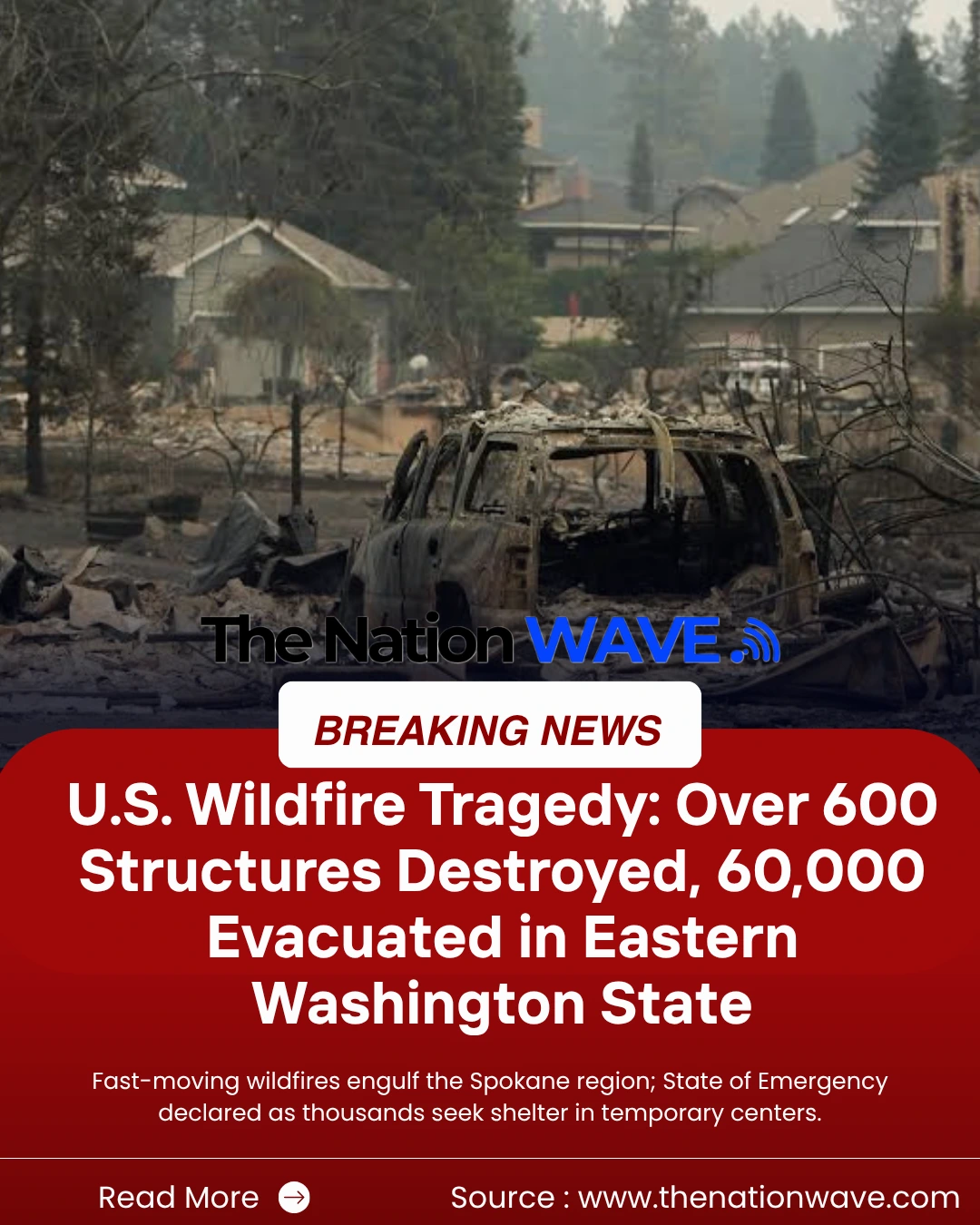
U.S. Wildfire Tragedy: Over 600 Structures Destroyed, 60,000 Evacuated in Eastern Washington State
Fast-moving wildfires engulf the Spokane region; State of Emergency declared as thousands seek shelter in temporary centers.
WASHINGTON, U.S.: Fast-moving, wind-driven wildfires have wrought unprecedented destruction across eastern Washington state, burning over 600 structures and forcing approximately 60,000 residents to flee their homes under mandatory evacuation orders.
The catastrophic blazes—centered heavily around Spokane, the state’s second-largest city—have swept through thousands of acres of residential neighborhoods, timber, and farmland. Plumes of thick smoke have choked the skies, prompting state officials to declare a State of Emergency and enforce region-wide burn bans as firefighting crews struggle to establish containment.
Extent of the Destruction: 600+ Structures Lost, Thousands Threatened
According to local emergency management authorities, the fires moved at an alarming speed, leaving residents with only minutes to gather essential belongings and evacuate.
- Heavy Structural Loss: Initial damage assessments confirm that over 640 structures—primarily single-family homes, commercial businesses, and outbuildings—have been reduced to ash.
- Mass Evacuations: Around 60,000 people have been displaced from their homes, with many forced to seek safety in emergency shelters, hotels, or with relatives outside the danger zone.
- Hospitals Impacted: Safety precautions led to the partial evacuation and transfer of patients from local medical facilities, including the Mann-Grandstaff VA Medical Center in Spokane.
- Ongoing Threat: Fire officials estimate that over 4,000 additional structures remain directly threatened as wind gusts continue to push the fire lines forward.
Aerial photos and ground footage show entire neighborhoods leveled, leaving behind only brick chimneys and burned-out vehicle frames.
The Spokane Complex Fire: How It Spread So Quickly
Dubbed the Spokane Complex Fire, the disaster comprises multiple merging blazes—including the Old Trail Fire, Fairview Fire, and Autumn Lane Fire.
- Rapid Growth: Within hours of ignition, the combined fires consumed more than 7,700 acres.
- Canyon Topography: The geographic features of the Spokane River gorge acted as a natural wind tunnel, channeling fierce gusts up steep canyon walls and accelerating the flame front toward populated areas.
- Zero Percent Containment: During the critical initial hours, firefighters faced 0% containment, severely limiting their ability to create defensible lines.
Severe Weather Conditions Fuel the Flames
Meteorologists point out that the catastrophe is the result of a dangerous combination of prolonged drought, unseasonably high temperatures, and extreme wind conditions.
The National Weather Service issued a Particularly Dangerous Situation (PDS) Red Flag Warning for eastern Washington and parts of neighboring Oregon.
- Gale-Force Winds: Wind gusts reaching 35 to 45 mph (56 to 72 km/h) carried burning embers miles ahead of the main fire front, starting new “spot fires” in unburned neighborhoods.
- Severe Air Quality Degradation: Heavy smoke has triggered severe air quality advisories across Washington, Idaho, Oregon, and Montana. Officials have urged vulnerable populations, including children and the elderly, to stay indoors.
Spokane Fire Department Public Information Officer Benjamin Cosel noted: “The terrain and weather are working directly against us. Steep canyons create unpredictable fire behavior that makes direct attack extremely hazardous.”
Emergency Response: Shelters, National Guard, and Federal Aid
A massive relief effort is currently underway across the state:
- Convention Center Transformed: The Spokane Convention Center has been converted into a primary emergency shelter, providing meals, medical care, and temporary lodging for displaced families.
- National Guard Deployment: Washington National Guard troops have been deployed to assist local police with traffic control, search-and-rescue operations, and perimeter security.
- Federal Assistance (FEMA): Governor officials have requested emergency declarations from the Federal Emergency Management Agency (FEMA) to unlock federal funding and specialized firefighting assets.
Spokane Mayor Lisa Brown addressed the community, stating: “This is undoubtedly one of the most severe natural disasters our region has faced in modern history. Our immediate priority is saving lives.”
Eyewitness Accounts: “An Wall of Black Smoke”
For thousands of fleeing residents, the escape was harrowing.
Spokane County Commissioner Chris Jordan shared that his own family members had to flee the advancing flames: “When they were driving out, it was just a solid wall of black smoke. You couldn’t see what was behind you, and you didn’t know if your home would be there when you returned. It’s a terrifying ordeal for thousands of families right now.”
Gridlocked traffic was reported on primary escape routes as families loaded pets, important documents, and basic necessities into their vehicles to escape the advancing fire.
Climate Context: Increasing Wildfire Risk in the American West
Environmental experts emphasize that the rising frequency and intensity of wildfires in the U.S. Pacific Northwest are closely linked to broader climate trends:
- Extended Drought Cycles: Winters with reduced snowpack followed by hot, dry summers leave vegetation extremely dry and flammable by late summer.
- Fuel Accumulation: Drier conditions turn forests and grasslands into dense fuel beds where even a small spark—from lightning or human activity—can spark a megafire.
- Strained Resources: With simultaneous fires burning across neighboring states, regional firefighting resources and air tankers are stretched to their limits.
Looking Ahead
With weather forecasts predicting continued high temperatures and no immediate rainfall, emergency agencies warn that the danger is far from over. U.S. Senator Maria Cantwell stated, “We are still in the thick of this fight. The coming days will require immense coordination and resilience.”
Local authorities continue to urge all residents in affected zones to monitor official evacuation alerts closely. Rebuilding the destroyed infrastructure and supporting 60,000 displaced residents will likely take months, if not years, for eastern Washington.